
Post-BTO Renovation Carpet & Soft Furnishing Extraction: Removing Crystalline Silica & Gypsum Construction Dust (2026 Singapore Technical Guide)
July 29, 2026
Singapore Haze Season Survival: Extracting Trapped PM2.5 Particles from Home Carpets & Soft Furnishings (2026 Technical Guide)
July 31, 2026Singapore Office Carpet Monsoon Moisture Control: Preventing Mold, Fungal Spores & Musty Odors (2026 Commercial Guide)
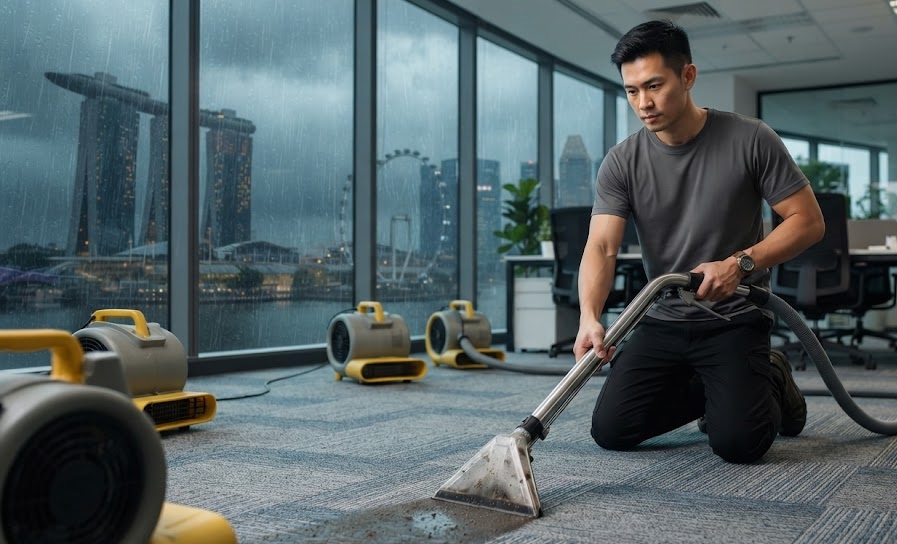
Singapore commercial towers across Raffles Place, Tanjong Pagar, Marina Bay, and Jurong East operate under relentless tropical atmospheric conditions. During the Northeast Monsoon (November through March) and Southwest Monsoon (May through September), torrential rains and intense cloud cover elevate ambient relative humidity (RH) above 90% for days at a time. While commercial office layouts rely almost exclusively on modular synthetic carpet tiles over raised access floors to absorb acoustic reverberation and accommodate cabling, these floor systems double as dynamic moisture reservoirs.
Every wet umbrella brought into a lift lobby, every pair of damp shoes stepping off MRT concourses into open-plan workstations, and every cubic meter of humid outdoor air introduced through central building ventilation systems adds water vapor into carpet face yarns. When indoor air management systems shut off overnight to meet commercial energy conservation targets, this accumulated moisture causes rapid fungal colonization, backing degradation, and localized outbreaks of pungent musty odors. Preventing commercial property damage and safeguarding workforce health requires a deep understanding of office psychrometrics, moisture migration, and specialized extraction engineering.
Psychrometrics of Singapore Monsoon Seasons: Indoor Air Handling & Carpet Moisture Traps
Commercial office environments in Singapore operate under strict psychrometric parameters. During standard business hours (8:00 AM to 7:00 PM), central building Air Handling Units (AHUs) or Variable Air Volume (VAV) chiller systems maintain indoor temperatures between 21°C and 23°C, keeping indoor relative humidity conditioned down to 55%–65%. This thermal equilibrium conceals the hidden moisture load trapped within floor coverings.
The primary driver of monsoon mold outbreaks in Singapore offices is the Nighttime Thermal Setback Trap:
- Phase 1: Operational Cooling (Daytime): Cold air circulating from ceiling diffusers chills the concrete slab, steel raised-floor panels, and heavy bitumen or cushion-backed carpet tiles down to 21°C. Simultaneously, rainwater tracked in by employees creates damp patches across main walkways and reception zones.
- Phase 2: System Shutdown (7:00 PM): Central AHU fans cut out at the end of the corporate workday. Fresh outdoor air intake dampers seal, but ambient humidity creeps through building envelope gaps, service shafts, and lift cores.
- Phase 3: Thermal Inversion & Dew Point Convergence (10:00 PM – 4:00 AM): Ambient air inside the sealed office suite warms rapidly to 28°C–30°C while relative humidity climbs past 85%. Because the dense carpet tiles and sub-floor slabs retain cold thermal mass from daytime air conditioning, warm humid air hits the cold carpet face. Indoor temperature meets the dew point temperature right at the carpet backing interface, triggering micro-condensation across thousands of square feet of flooring.
This repeating daily cycle of daytime wetting, evening warming, and overnight condensation creates a ideal micro-environment for microbial growth directly beneath employees’ desks.
The Biology of Office Carpet Odors: Microbial Volatile Organic Compounds (mVOCs)
The distinctive, heavy “musty office smell” encountered when stepping into a commercial unit on Monday morning is not merely stale air; it is the direct gaseous byproduct of active fungal metabolism. When carpet tile moisture levels exceed a critical water activity threshold ($a_w > 0.65$), dormant fungal spores spores—specifically Aspergillus versicolor, Penicillium citrinum, and environmental Actinomycetes—germinate within 24 to 48 hours.
These microorganisms secrete digestive enzymes to break down organic contaminants trapped between nylon filaments, including skin squames, beverage spills, and soil tracked in from outside. As fungi digest these organic substrates under high humidity, they release chemical vapors known as Microbial Volatile Organic Compounds (mVOCs). Common carpet-borne mVOCs include:
- 1-Octen-3-ol: Delivers an intense, earthy mushroom scent highly noticeable in enclosed meeting rooms.
- Geosmin & 2-Methylisoborneol: Creates a pungent damp-basement odor that clings to clothing and upholstered office chairs.
- 3-Methylfuran & 2-Hexanone: Pungent chemical vapors that trigger upper respiratory irritation, eye stinging, and lethargy among office staff.
Simply spraying masking fragrances or running aerosol room fresheners does nothing to eliminate mVOC sources. Masking agents temporarily cover odor molecules while adding additional volatile compounds into the indoor air stream. True remediation demands physical liquid extraction of the fungal colonies and metabolic byproducts bound inside the carpet pile.
| Remediation Protocol | Moisture Removal Capacity (%) | Sub-Floor Liquid Penetration Risk | Drying Time (Unconditioned RH 85%) | mVOC & Spore Neutralization Rate (%) | Operational Office Downtime |
|---|---|---|---|---|---|
| Standard Commercial Dry Vacuuming | 0% (Dry process) | Zero risk | Immediate (No moisture added) | Less than 10% (Leaves fungal hyphae intact) | Zero downtime |
| Dry Compound Powder Cleaning | 15% – 25% (Absorbs surface moisture) | Zero risk | 30 – 45 Minutes | 30% – 40% (Temporary odor suppression) | Minimal / 1 Hour |
| Low-Moisture Encapsulation Cleaning | 40% – 55% | Low risk | 1.5 – 2 Hours | 55% – 65% (Polymers lock surface spores) | 1 – 2 Hours |
| Dual-Vacuum Hydro-Extraction + Axial Air Drying | 92% – 97% | Controlled (Low-volume high-lift wand) | 2.5 – 4 Hours (Complete sub-floor dry) | 95% – 99% (Full bio-extraction & flush) | After-office hours / Overnight |
Engineering Deep Moisture Extraction & Mold Neutralization Protocols
Remediating saturated office carpet tiles during peak monsoon months requires high-performance commercial equipment engineered for low water volume and high vacuum recovery. Traditional residential carpet cleaning wands dump excessive water volumes into floor coverings, driving moisture straight through tile joints and pooling water on steel access floor plates or concrete slabs. In commercial high-rises, unrecovered water under carpet tiles leads to backing glue breakdown, carpet tile cupping, and catastrophic mold blooms beneath raised floors.
Professional commercial protocols utilize a engineered four-step hydro-extraction framework:
1. Targeted Antimicrobial Pre-Conditioning
Before liquid extraction begins, carpet tiles are treated with a specialized low-volume mist of broad-spectrum quaternary ammonium compounds (QACs) blended with bio-enzymatic odor neutralizers. This pre-spray breaks down the protective cell membranes of mold spores and neutralizes active mVOC molecules on contact without oversaturating the carpet pile.
2. High-Shear Agitation via Counter-Rotating Brushes (CRB)
Dual cylindrical counter-rotating brush machines lift matted low-pile commercial carpet fibers, scrubbing the antimicrobial pre-spray down into the primary backing. This mechanical action dislodges sticky fungal hyphae and embedded mud tracked in during monsoon rainstorms.
3. Dual-Vacuum Low-Volume Hydro-Extraction
Extraction wands equipped with dual vacuum slots and high-pressure fluid jets operating at 200 to 300 PSI inject heated rinsing solutions (60°C) while immediately recovering dirty effluent. High vacuum lift—measured at 135 to 150 inches of water lift—recovers over 95% of injected fluid in a single pass. Facility managers seeking professional compliance can schedule specialized maintenance through commercial office carpet cleaning services tailored specifically for CBD corporate spaces.
4. High-Velocity Directed Laminar Air Drying
Immediately following extraction pass completion, industrial axial air movers are deployed across floor sections. These units force high-velocity air streams horizontally across the carpet face, breaking the boundary moisture layer and forcing rapid evaporation before building AHUs undergo nighttime setback.
MOM Workplace Health Standards & SS 554 Indoor Environmental Quality Benchmarks
Maintaining clean commercial flooring is not merely an aesthetic concern; it is a regulatory workplace health requirement in Singapore. Under Ministry of Manpower (MOM) Workplace Safety and Health (WSH) guidelines and Singapore Standard SS 554 (Code of Practice for Indoor Air Quality in Air-Conditioned Buildings), employers and building facility managers must maintain indoor environmental quality free from bio-aerosol hazards.
SS 554 specifies quantitative indoor environmental limits for commercial spaces:
- Total Airborne Fungal Count: Must remain below 500 Colony Forming Units per cubic meter (CFU/m³). Unmaintained damp carpets during monsoon periods frequently generate localized counts exceeding 2,500 CFU/m³.
- Indoor Relative Humidity: Recommended operating range between 50% and 70%. When carpet dampness drives localized humidity past 75%, microbial amplification accelerates rapidly.
- Total Volatile Organic Compounds (TVOCs): Must not exceed 3 ppm over an 8-hour weighted average. Microbial volatile organic compounds (mVOCs) off-gassing from damp bitumen carpet backings contribute directly to elevated TVOC spikes.
When damp commercial carpets remain unaddressed, fungal spores circulate through return-air plenums into central HVAC ducting. This spreads micro-spores throughout entire floor plates, triggering Sick Building Syndrome (SBS). Office workers report persistent lethargy, sinus congestion, skin irritations, and dry throat complaints. Investing in scheduled post-monsoon hydro-extraction mitigates corporate absenteeism while maintaining full compliance with MOM workplace health inspections.
Most Grade-A CBD towers in Raffles Place and Marina Bay isolate building power circuits after hours. When executing evening carpet hydro-extraction, coordinate with building management to ensure 13A floor box power circuits remain energized overnight. Position axial air movers in a continuous perimeter vortex configuration, angling airflow at 45 degrees along walls, while running commercial desiccant dehumidification units set to target 40% RH. This combination extracts moisture out of carpet tiles before morning staff arrival without relying on central AHU operation.
Carpet Tile Substrates & Sub-Floor Moisture Vapor Emission Rates (MVER)
Remediating moisture in commercial carpets requires evaluating the physical composition of carpet tile backings and the underlying concrete slab construction. Unlike broadloom carpets attached to felt underlayments, modular office carpet tiles utilize engineered multi-layer backings designed for dimensional stability under heavy rolling-chair traffic.
1. Bitumen and Modified PVC Backing Systems
Traditional commercial carpet tiles utilize heavy bitumen or vinyl backings. These materials act as total vapor barriers. While this prevents spilled liquids on the surface from soaking down into the concrete floor, it works both ways: moisture trapped beneath the tile during monsoon floods cannot evaporate upward. This trapped water leads to plasticizer migration, adhesive degradation, and a sticky residue (alkaline hydrolysis) oozing through tile seams.
2. Cushion-Backed Polyurethane Foam Tiles
Modern acoustic office tiles feature open-cell polyurethane foam backings. While offering superior ergonomics and sound absorption in open-plan call centers, open-cell foam acts like an absorbent sponge when exposed to rainwater tracking or excessive cleaning solution. Hydro-extraction on cushion-backed tiles requires specialized dual-vacuum passes with high water lift (minimum 140 inches H2O) to pull liquid out of the foam structure without crushing the cell walls.
3. Concrete Slab Moisture Vapor Emission Rate (MVER)
In Singapore high-rise office buildings, sub-floor concrete slabs continually exchange moisture with ambient air. Before performing deep carpet restoration, facility teams should measure slab moisture using non-destructive impedance meters or calcium chloride test kits (ASTM F1869). A slab MVER exceeding 3.0 lbs/1,000 sq ft/24 hours indicates active sub-slab vapor drive, requiring specialized low-moisture hydro-extraction protocols to prevent trapping liquid beneath new carpet tile installations.
Facility Management Moisture Inspection & Audit Checklist
Facility managers, office administrators, and operations directors should conduct systematic floor audits throughout monsoon seasons to detect moisture accumulation before mold colonies establish. Use this diagnostic inspection protocol:
1. Thermal Imaging Infrared Inspection (FLIR Audit)
Scan carpeted floor suites using a calibrated thermal imaging camera. Evaporative cooling from hidden dampness creates distinct blue/purple thermal anomalies on the display screen. Pay special attention to perimeter walls under glass curtain facades, areas surrounding executive pantry fridges, and main entrance walkways.
2. Pinless Surface Moisture Meter Testing
Press a non-destructive radio-frequency moisture meter across suspected carpet tiles. Standard dry commercial carpet tile reads between 0% and 12% Wood Moisture Equivalent (WME). Meter readings exceeding 18% WME indicate active liquid saturation inside the carpet tile backing, requiring immediate extraction intervention.
3. Raised Floor Void Inspection
Lift representative carpet tiles above raised-access floor panels in high-traffic corridors. Inspect steel panel joints and pedestal bases for white mineral efflorescence, rust spots, or visible dark mold spots. Check that data cables lying inside the void are not resting in pooled condensation water.
4. Relative Humidity Log Comparison
Place standalone data-logging hygrometers at floor level inside internal meeting rooms overnight. If floor-level RH remains consistently above 70% while ceiling supply diffusers read 55% RH during business hours, the carpet face is emitting accumulated moisture into the local micro-climate.
Frequently Asked Questions
Why does our Singapore office smell musty every Monday morning during the monsoon season?
The Monday morning office odor occurs because central air conditioning systems are switched off over the weekend. Monsoon rains elevate indoor relative humidity above 85% inside sealed office towers. Moisture trapped inside carpet tiles from Friday rainwater foot traffic reacts with warm weekend temperatures, triggering fungal germination and off-gassing musty Microbial Volatile Organic Compounds (mVOCs) into the unventilated room air.
Can commercial carpet tiles be deep-cleaned without causing sub-floor water damage or glue delamination?
Yes, provided high-lift dual-vacuum commercial extraction wands are used. Unlike domestic wands, commercial extraction systems calibrate water pressure precisely (200–300 PSI) while pulling high negative vacuum lift (135+ inches of water lift). This recovers over 95% of injected fluid immediately, preventing liquid from penetrating through bitumen tile seams into sub-floor adhesives or raised access floor plates.
How quickly does mold grow on wet office carpets if the building AHU is switched off overnight?
Under tropical Singapore indoor conditions (temperatures between 26°C and 30°C with relative humidity above 80%), fungal spores germinate within 24 to 48 hours. If rain-saturated carpets remain damp over a weekend without active ventilation or dehumidification, microscopic mold colonies colonize the carpet backing by Sunday evening.
What is the recommended drying time for commercial office carpets after deep extraction in high humidity?
Target drying times should always fall under 4 hours to prevent fungal reactivation. Professional extraction teams achieve this by deploying high-velocity axial air movers blowing horizontally across floor tiles immediately behind extraction operators. Running room dehumidifiers or building air conditioning in dry mode further accelerates complete moisture equilibrium.
Safeguarding Commercial Real Estate & Air Quality
Proactive moisture control is essential for managing commercial office spaces in Singapore. Protecting corporate floor coverings against monsoon humidity, mold colonization, and mVOC off-gassing ensures full compliance with MOM workplace health standards while preserving valuable commercial real estate assets.
Is your CBD office suite experiencing persistent musty odors or monsoon dampness across carpeted floor plates? Contact our commercial floor engineering specialists through our commercial consultation booking page to schedule an on-site thermal moisture audit and off-hours deep extraction assessment.