Singapore Pre-Festive Carpet Revitalization: Traffic Lane Restoration & Food Stain Extraction (2026 Guide)
July 27, 2026
Post-BTO Renovation Carpet & Soft Furnishing Extraction: Removing Crystalline Silica & Gypsum Construction Dust (2026 Singapore Technical Guide)
July 29, 2026Singapore CBD Office Carpet Bio-Sanitization: Eradicating Hidden Pathogens & Bacteria (2026 Commercial Guide)
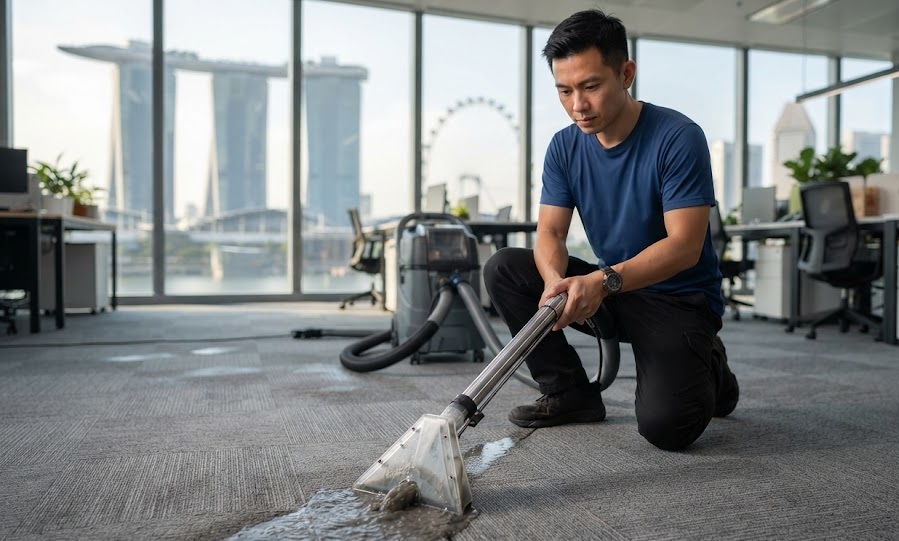
As multinational corporations, financial institutions, and tech enterprises across Singapore enforce firm return-to-office (RTO) policies, corporate towers in Raffles Place, Tanjong Pagar, Marina Bay Financial Centre (MBFC), and Suntec City are reaching peak daily occupancy rates. Open-plan floor plates designed around agile hot-desking, shared collaboration pods, and high-density workstation clusters accommodate thousands of professionals daily. While corporate facility managers prioritize surface wipe-downs of desks and door handles, an expansive biological reservoir remains active beneath employees’ feet: commercial carpet tiles.
Commercial synthetic carpet tiles serve as giant, continuous passive collectors for bio-contaminants. An average working adult sheds approximately 1.5 grams of dead skin squames every 24 hours. In a 200-pax office suite, this equates to 300 grams of organic cellular material deposited into floor coverings every single day. Combined with shoe-borne pathogens tracked in from MRT concourses, hawker center floors, and public walkways, commercial carpet tiles accumulate complex microbial loads that standard janitorial vacuuming cannot eliminate.
CBD Return-to-Office Mandates & The Bio-Burden in Commercial Carpets
High occupant density—often compressed to 8 to 10 square meters per workstation in modern Singapore office layouts—fundamentally changes the microbiological environment of commercial real estate. Unlike traditional offices with assigned seating, hot-desking setups increase human movement across shared floor zones. Employees move continuously between team pods, meeting rooms, pantry zones, and phone booths, distributing biological material across the entire carpet matrix.
Microbiological sampling of commercial office carpets reveals four distinct bio-burden categories:
- Human Skin Squames & Keratin Debris: Provides a continuous protein nutrient source for dust mites and indigenous bacterial colonies embedded inside carpet face yarns.
- Footborne Environmental Pathogens: Shoes worn across urban Singapore transport soil-borne bacteria, including Escherichia coli, Enterococcus faecalis, and Pseudomonas aeruginosa, straight off public sidewalks into air-conditioned office suites.
- Aerosolized Respiratory Droplet Residues: Coughing, sneezing, and talking in enclosed meeting spaces send respiratory droplets ($Influenza\ A/B$, $Human\ Rhinovirus$, $Norovirus$) settling onto carpet fibers, where viral capsids remain protected inside dried mucus envelopes for days.
- Pantry Organic Liquid Spills: Coffee, milk, sugary teas, and food crumbs dropped in workstation aisles decay under ambient room humidity, creating nutrient-rich breeding zones for mold spores and bacterial biofilms.
As employees walk across saturated carpet tiles, mechanical foot impact compresses the pile fibers. This compression creates localized air bursts that re-suspend microscopic bio-pathogens into the human breathing zone (1.0 to 1.5 meters above floor level), contributing directly to unexplained workplace absenteeism and seasonal flu spikes.
Why Routine Janitorial Dry Vacuuming Fails to Neutralize Bio-Pathogens
Standard nightly janitorial contracts rely on commercial upright or backpack vacuum cleaners to maintain visual floor cleanliness. While dry vacuuming removes loose surface lint and coarse dirt granules, it cannot sanitize carpet fibers or eliminate biological pathogens.
Nightly dry vacuuming falls short due to three technical limitations:
1. The “Bio-Aerosol Plume” Vacuum Exhaust Hazard
Most standard commercial backpack vacuums utilize basic cloth filter bags or low-grade primary paper filters. When these machines pass over dry, pathogen-laden carpet tiles, the high-velocity motor intake pulls bacteria and viral particles off the pile. Lacking true, fully sealed H14 HEPA exhaust filtration, the vacuum engine pulverizes dried organic clusters and ejects an aerosol plume of sub-micron pathogens straight back into the office air column.
2. Bacterial Biofilm Extracellular Matrix Protection
Bacteria living inside carpet tile bases do not exist as isolated single cells. They construct protective slime shields called Extracellular Polymeric Substances (EPS). This biofilm matrix glues bacterial colonies to synthetic nylon and polypropylene fibers. Dry vacuum beaters and suction heads cannot break this sticky EPS shield without liquid thermal or chemical intervention.
3. The Superficial Ineffectiveness of Disinfectant Fogging
Following illness outbreaks, facility managers often order electrostatic disinfectant fogging. While chemical mists coat exposed desk tops and upper carpet fiber tips, surface fogging lacks hydraulic penetration depth. Fogging droplets cannot pass through dense face yarns to reach the lower two-thirds of the carpet pile where 90% of organic sludge and bacterial biofilms reside.
| Sanitization Protocol | Bacterial & Viral Log Reduction (CFU/cm²) | Biofilm EPS Matrix Breakdown Depth | Sub-Floor Moisture & Tile Curling Risk | Residual Chemical Tackiness | Asset Lifespan Extension Impact |
|---|---|---|---|---|---|
| Nightly Dry Janitorial Vacuuming | 0.2 Log Reduction (15% – 25%) | Zero (Dry mechanical pass only) | Zero risk | None | Poor (Dry grit continues abrading backing) |
| Surface Disinfectant Electrostatic Fogging | 1.5 Log Reduction (90% – 95% surface) | 1mm – 2mm (Top fiber tips only) | Zero risk | Moderate (Sticky disinfectant film) | Negligible (Leaves organic soil inside pile) |
| Low-Moisture Rotary Bonnet Cleaning | 2.1 Log Reduction (98% – 99%) | 4mm – 6mm (Mid-pile surface) | Low risk | Moderate (Shampoo residues attract dirt) | |
| Thermal Hydro-Extraction + 4th-Gen QACs | 5.0+ Log Reduction (99.999% Hospital-grade) | 18mm – 25mm (Full backing flush) | Controlled (Low-volume high-lift extraction) | Zero (Acidic rinse strips residue) | Maximum (Extends tile life by 3–5 years) |
Thermal Hydro-Extraction & Quaternary Bio-Sanitization Engineering
Eradicating deeply embedded bio-pathogens from commercial office carpet tiles requires combining high-temperature fluid dynamics with advanced antimicrobial chemistry. Professional floor restoration protocols utilize a specialized two-stage bio-extraction technique engineered for high-density commercial real estate.
Stage 1: Thermal Denaturation and EPS Solubilization
Operating fluid temperatures between 85°C and 95°C at the wand nozzle delivers thermal energy directly to carpet fibers. At these elevated temperatures, viral lipid envelopes ($Influenza$, $Coronaviruses$) denature instantly, rendering viral capsids non-infectious. Simultaneously, heat softens the sticky extracellular polymeric substances (EPS) holding bacterial biofilms together, breaking their bond to nylon and polypropylene filaments.
Stage 2: Broad-Spectrum 4th-Generation Quaternary Ammonium Compounds (QACs)
To ensure complete destruction of non-enveloped viruses and spore-forming bacteria, high-temperature fluid delivery is combined with twin-chain 4th-generation Quaternary Ammonium Compounds (QACs). Unlike harsh sodium hypochlorite (bleach) that destroys carpet dyes, 4th-gen QACs feature dual lipophilic alkyl chains that puncture bacterial cell membranes on contact, providing hospital-grade disinfection while remaining completely color-safe for commercial carpet tiles.
Facility directors and operations leads seeking complete floor hygiene compliance can review specialized service offerings through commercial office carpet cleaning services engineered for CBD corporate towers.
MOM Workplace Safety & SS 554 Compliance for Enterprise Facilities
Maintaining a biologically clean workplace is a core operational requirement under Singapore law. Under the Ministry of Manpower (MOM) Workplace Safety and Health Act (WSHA), employers and building owners share a legal duty of care to eliminate biological hazards that compromise employee well-being. Furthermore, compliance with Singapore Standard SS 554 (Code of Practice for Indoor Air Quality in Air-Conditioned Buildings) sets clear bio-aerosol benchmarks for Grade-A commercial real estate.
SS 554 guidelines dictate that total indoor airborne bacterial and fungal counts must not exceed 500 Colony Forming Units per cubic meter (CFU/m³). When carpets are neglected during high-occupancy return-to-office periods, microbial activity within carpet face yarns regularly generates localized bio-aerosol counts exceeding 3,000 CFU/m³ whenever employees walk across workstation aisles.
Beyond regulatory health compliance, deep thermal bio-extraction yields major financial asset management advantages:
- Delaying CAPEX Carpet Replacement: Heavy commercial nylon carpet tiles represent significant capital expenditure (typically $45 to $85 per square meter installed). Unextracted grit, skin oils, and acidic coffee spills break down synthetic fiber polymers, causing premature matting and backing delamination within 4 years. Scheduled bio-extraction removes abrasive particulates, extending carpet tile service life to 8–10 years.
- Reducing Sick Leave Absenteeism: Eliminating carpet-borne viral and bacterial reservoirs directly lowers cross-infection rates in open-plan office layouts, preserving workforce productivity during peak seasonal flu waves.
- Protecting Corporate Sustainability (GFA & Green Mark): Extending flooring asset lifespan reduces landfill waste, contributing directly to corporate ESG benchmarks and BCA Green Mark building certification points.
Most Grade-A commercial towers in Raffles Place and Marina Bay shut down primary AHUs at 1:00 PM on Saturdays. When scheduling weekend deep bio-extraction, submit building management tenant work applications at least 5 business days in advance to request auxiliary cooling overrides or fan-only ventilation from 6:00 PM Saturday to 6:00 AM Sunday. Deploying portable axial air movers alongside building fan ventilation guarantees 100% moisture evaporation before Monday morning staff intake.
Carpet Tile Asset Preservation: Protecting Bitumen and Polyurethane Substrates
Commercial carpet tiles engineered for CBD high-rises utilize specialized multi-layer backing systems designed to withstand heavy rolling office chair loads. Understanding backing chemistry is critical when selecting extraction cleaning parameters.
1. Bitumen and Modified PVC Backings
Bitumen backings provide exceptional dimensional stability and flame resistance. However, when sugary coffee, tea, or milk spills penetrate bitumen tile seams, the combination of organic sugar and high moisture triggers anaerobic bacterial decay at the concrete slab junction. This process releases acidic byproducts that degrade backing adhesives, causing carpet tile edges to curl upward (cupping) and creating trips hazards. Thermal hydro-extraction flushes these acidic organic residues out of tile seams before adhesive breakdown occurs.
2. Cushion-Backed Polyurethane Foam Tiles
Designed for acoustic sound absorption in open-plan corporate trading floors, polyurethane cushion backings act like microscopic sponges. If janitorial teams use excessive water volume during cleaning without sufficient vacuum recovery, liquid pools inside the polyurethane cell matrix, fostering rapid fungal growth. Extraction on cushion-backed tiles requires dual-vacuum wands generating over 140 inches of water lift, ensuring liquid is pulled completely out of the cushion core.
Enterprise Facility Hygiene Inspection & ATP Bioluminescence Audit
Modern enterprise facility management requires objective, verifiable proof of cleanliness rather than subjective visual inspections. Professional sanitization protocols utilize Adenosine Triphosphate (ATP) bioluminescence swab testing to measure biological activity before and after deep extraction passes.
ATP is the universal energy molecule present in all living cells, including human skin squames, bacterial colonies, mold spores, and organic food residues. The swab audit process follows three standardized steps:
Step 1: Baseline Swabbing & Luminescence Reading
A pre-cleaned 10cm x 10cm carpet tile section in a high-traffic corridor is swabbed using a sterile swab pen. The swab is activated in a handheld luminometer meter, providing a digital reading measured in Relative Light Units (RLU).
- Unmaintained Hot-Desking Carpet: Typically registers between 1,200 and 3,500 RLU (Extremely high bio-contamination).
- Visually Cleaned Janitorial Floor: Typically registers between 500 and 950 RLU (Fails hospital hygiene benchmarks).
Step 2: Thermal Bio-Extraction Execution
The designated floor area undergoes high-temperature hydro-extraction combined with broad-spectrum 4th-generation quaternary ammonium compounds (QACs).
Step 3: Post-Extraction Verification Audit
A adjacent carpet section is swabbed immediately post-drying. Successful bio-sanitization reduces surface ATP readings to below 50 RLU, matching strict healthcare and food-grade hygiene standards.
Frequently Asked Questions
How often should CBD offices perform deep sanitization on carpet tiles?
For Grade-A office suites in Singapore with high occupant density (above 100 employees), scheduling deep thermal bio-extraction every 6 months is recommended. High-traffic zones such as lift lobbies, main reception areas, and pantry corridors should undergo quarterly sanitization passes to prevent bio-pathogen buildup.
Does surface disinfectant fogging replace the need for hot water carpet extraction?
No. Electrostatic disinfectant fogging coats the top surface of furniture and upper fiber tips but cannot penetrate into the carpet tile backing where 90% of organic sludge, skin squames, and bacterial biofilms reside. Thermal hydro-extraction physically flushes contaminants out of the floor, whereas fogging merely sanitizes the surface face yarn.
Can carpet sanitization be completed overnight without disrupting office operations the next morning?
Yes. Commercial extraction systems utilize dual-vacuum high-lift recovery wands that recover up to 95% of injected fluid during the pass. Combined with professional high-velocity axial air movers blowing across floor plates, carpet tiles dry completely within 2 to 3 hours, ensuring zero operational downtime for corporate staff arriving the next morning.
Will thermal steam extraction damage carpet tile backing adhesives or cause tile curling?
Not when conducted by certified commercial technicians. Commercial extraction wands deliver controlled low-volume, high-pressure fluid bursts (200–300 PSI) that sanitize face yarns without forcing water through bitumen seams into pressure-sensitive tackifier adhesives. Vacuum recovery immediately pulls liquid out, preventing tile edge curling or sub-floor adhesive breakdown.
Safeguarding Workforce Health & Commercial Real Estate Assets
Eliminating hidden bio-pathogens from commercial floor plates is essential as corporate workforce density climbs across Singapore’s CBD. Combining high-temperature thermal extraction with broad-spectrum bio-sanitizers protects employee health, satisfies SS 554 indoor air benchmarks, and adds years of operational service life to commercial carpet assets.
Is your corporate facility preparing for increased office occupancy or seeking a comprehensive floor hygiene audit? Contact our enterprise floor care engineering team today through our commercial consultation portal to schedule an on-site ATP bioluminescence audit and tailored off-hours sanitization proposal.