

Singapore CBD Office Carpet Bio-Sanitization: Eradicating Hidden Pathogens & Bacteria (2026 Commercial Guide)
July 28, 2026
Singapore Office Carpet Monsoon Moisture Control: Preventing Mold, Fungal Spores & Musty Odors (2026 Commercial Guide)
July 30, 2026Post-BTO Renovation Carpet & Soft Furnishing Extraction: Removing Crystalline Silica & Gypsum Construction Dust (2026 Singapore Technical Guide)
Receiving keys to a new HDB Build-To-Order (BTO) flat or private condominium under Temporary Occupation Permit (TOP) marks an exciting milestone for Singapore homeowners. Estates across Tengah, Bidadari, Tampines North, and Punggol witness continuous waves of interior fitting works. Homeowners invest tens of thousands of dollars in extensive hacking, masonry tiling, partition wall construction, custom carpentry installation, and multi-coat interior painting to transform bare concrete shells into functional living spaces.
Once contractors declare chemical washing complete and hand over the keys, homeowners move soft furnishings, designer area rugs, and wall-to-wall carpets into their living rooms and bedrooms. Within weeks, many occupants notice an uncomfortable reality: carpets placed in newly renovated flats quickly become stiff, chalky, and continuously release fine grey dust whenever stepped on. Running a high-end domestic vacuum cleaner or smart robot vacuum fails to resolve the problem. Understanding why post-renovation dust behaves differently from everyday household soil requires examining the chemical makeup and physical dynamics of construction particulates.
The Micro-Physics of BTO Renovation Dust: Crystalline Silica, Gypsum & Alkalis
Everyday household dust consists primarily of organic skin scales, textile lint, outdoor soil particles, and pet dander. These organic particles are relatively soft, rounded, and measure between 20 and 100 micrometers in size. Construction dust generated during BTO interior fitting works belongs to an entirely different physical and chemical class. It is a hazardous mixture of inorganic micro-particulates created by high-speed mechanical cutting, grinding, sanding, and drilling.
Analysis of post-renovation dust captured from Singapore residential units reveals four distinct mineral components:
- Crystalline Silica ($SiO_2$): Generated during floor tile hacking, granite countertop cutting, and masonry wall drilling. Crystalline silica particles measure between 0.5 and 5.0 micrometers. Under microscopic examination, silica fragments display razor-sharp, irregular crystalline geometries. When trapped between carpet pile fibers, foot traffic forces these microscopic blades against nylon and wool filaments, sawing through yarn strands at the root level.
- Gypsum & Calcium Sulfate ($CaSO_4 \cdot 2H_2O$): Created during plastering, partition wall installation, and ceiling joint sanding. Gypsum dust consists of ultra-light, microscopic powder particles ($1.0 – 10.0\ \mu m$) that easily drift through interior air currents, penetrating deep into carpet primary backings.
- Portland Cement & Tile Grout Alkalis ($Ca(OH)_2$): Released during masonry screeding and tile grouting. Uncured cement dust contains calcium hydroxide, highly alkaline compounds exhibiting a pH between 11.5 and 13.0 when exposed to moisture.
- Aerosol Paint Binders & Timber Sawdust: Sanding custom cabinetry and spray-painting feature walls generates microscopic acrylic resin droplets and fine wood flour coated in synthetic VOC binders. These sticky particulates adhere to carpet fiber shafts like glue.
Because construction dust particles are extremely small and dense, they settle past the upper face yarn of carpets, embedding themselves directly into the primary latex backing and secondary mesh foundation. Once settled at the root level, simple dry surface suction cannot dislodge them.
Why Household Vacuums and Robovacs Fail Against Renovation Dust
Homeowners frequently wonder why expensive cyclonic vacuum cleaners or high-end robotic vacuums cannot clean carpets post-renovation. The failure of domestic cleaning appliances stems from three mechanical and chemical limitations:
1. Instantaneous Filter Blinding and Airflow Collapse
Domestic vacuum cleaners rely on air velocity, measured in Cubic Feet per Minute (CFM), to carry dirt up the intake wand. Fine gypsum and silica dust particles ($0.5 – 5\ \mu m$) bypass primary dust bin cyclones and instantly blind microscopic pores in secondary foam and HEPA filters. Within two minutes of vacuuming post-renovation carpet, system airflow drops by 70% to 90%. The vacuum engine continues running loudly, but physical suction velocity at the carpet face vanishes entirely.
2. Exhaust Re-Atomization of Respirable Particles
Most consumer vacuums lack fully sealed internal housing gaskets. High motor back-pressure caused by blinded filters forces fine silica dust past motor seals, blowing sub-micron construction particles back out through exhaust vents into your living room air column. Instead of removing the dust, dry domestic vacuuming redistributes invisible silica powder across your home.
3. The Alkaline Hydration Hazard in High Ambient Humidity
Singapore’s ambient relative humidity (70%–90%) interacts directly with trapped cement dust ($Ca(OH)_2$). Alkaline dust particles absorb ambient water vapor out of the air, undergoing a micro-hydration reaction. This reaction forms a chalky, microscopic cementitious crust around carpet fiber bases, gluing yarn tufts together. Dry vacuum beaters cannot break these chemical bonds without a liquid neutralizing agent.
| Cleaning Methodology | Fine Silica ($SiO_2$) Removal Efficiency | Alkaline Cement Neutralization | Backing Penetration Depth | Filter Blinding Risk | Fiber Abrasive Damage Prevention |
|---|---|---|---|---|---|
| Domestic Cyclonic / Robovac | 12% – 20% | Zero (Dry process) | 2mm – 4mm (Surface tufts only) | Extreme (Blinds filter in <2 mins) | Poor (Beater bar grinds silica into pile) |
| Industrial Dry HEPA Vacuuming | 45% – 58% | Zero (Dry process) | 6mm – 10mm (Mid-pile reach) | Controlled (Pulse-jet filter cleaner) | Moderate (Removes loose dry dust) |
| Low-Moisture Bonnet Cleaning | 35% – 48% | Minimal (Surface transfer) | 4mm – 6mm (Pushes dust down) | Low (Uses absorbent pads) | Poor (Spreads slurry laterally) |
| High-PSI Hydro-Extraction & Acidic Rinse | 94% – 98% | Complete (Acidic pH 5.0 neutralizer) | 18mm – 25mm (Flushes full backing) | None (Liquid slurry recovery) | Excellent (Dissolves sharp alkalis) |
Hydro-Extraction & Chemical Neutralization Mechanics for Renovation Debris
Remediating carpets contaminated with construction debris requires a combination of liquid chemical neutralization and high-pressure fluid dynamics. Simply washing a dust-laden carpet with standard high-pH soap or household laundry detergent worsens the problem, as alkaline detergents react with cement dust to form insoluble white salt deposits that permanently stiffen carpet pile.
Professional restoration follows a specialized chemical and physical extraction sequence:
Phase 1: Chemical Dissolution via Mild Acidic Rinse Chemistry
To break the microscopic crust formed by calcium hydroxide and gypsum residues, carpet fibers are treated with a low-pH acidic neutralizing rinse formulation ($pH\ 4.5 – 5.5$) containing organic hydroxycarboxylic acids. The acidic solution reacts chemically with alkaline cement salts:
Calcium Hydroxide [Alkaline Dust] + Hydroxycarboxylic Acid [Acid Rinse] → Soluble Calcium Salt + Water
This reaction neutralizes high-pH lime compounds, dissolving chalky binders and releasing bound silica particles from yarn filaments without damaging carpet dyes or synthetic fibers.
Phase 2: High-PSI Hydraulic Flushing (350 – 450 PSI)
Once chemical bonds dissolve, deep extraction machinery injects heated fluid (70°C–80°C) directly into the carpet pile at 350 to 450 PSI. High fluid velocity creates hydraulic turbulence at the primary backing interface, suspending heavy silica crystals in a fluid slurry.
Phase 3: High-CFM Dual-Vacuum Effluent Recovery
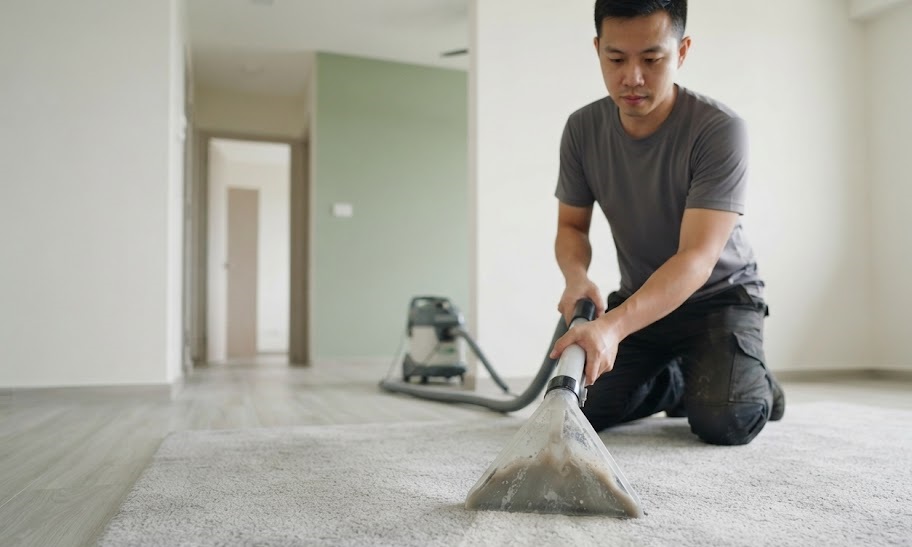
Simultaneous with fluid injection, twin high-lift vacuum motors generating over 135 inches of water lift seal against the carpet face. The vacuum draws the liquid slurry—containing dissolved alkalis, suspended gypsum, and crystalline silica—out of the carpet backing into a waste tank. Homeowners seeking complete post-renovation decontamination can request specialized assistance through specialized deep vacuuming and hot water extraction services designed to restore indoor air quality in new BTO flats.
NEA Indoor Environmental Health & Preventing Post-Renovation Respiratory Triggers
Ensuring complete decontamination of soft floor coverings following BTO renovation works directly affects long-term family health. The National Environment Agency (NEA) emphasizes indoor air cleanliness, particularly when newly renovated flats are occupied by vulnerable demographics such as newborn infants, young children, pregnant mothers, and elderly residents.
Respirable crystalline silica ($SiO_2$) and gypsum particulates trapped inside carpet pile present three specific health hazards when left unextracted:
- Mechanical Airway Irritation: Microscopic silica fragments measuring below 2.5 micrometers easily suspend into the air column when walking across untreated carpet. Inhaled sub-micron dust penetrates deep into lung alveoli, causing persistent dry coughs, throat scratchiness, and triggering bronchial asthma flares.
- Alkaline Contact Dermatitis: Toddlers crawling across carpets embedded with unneutralized cement dust ($pH\ 11.5 – 13.0$) experience direct skin contact with alkaline residues. Combined with sweat, this localized high-pH exposure causes skin redness, itching, and severe eczema flare-ups on tender hands and knees.
- Synergistic Volatile Organic Compound (VOC) Off-Gassing: Fine sawdust and gypsum dust absorb chemical off-gassing from newly applied wall paint, wood lacquers, and carpentry laminates. The dust acts as a secondary sponge, slowly re-emitting volatile organic compounds (TVOCs) into sealed air-conditioned bedrooms over many months.
Flushing construction dust out of carpet backings eliminates these exposure pathways, aligning indoor air quality with NEA guidelines for residential health and safety.
Never execute wet carpet extraction as the first step in a dusty room. Always follow a strict three-stage decontamination sequence: First, run an industrial HEPA air scrubber in the room for 60 minutes to capture suspended airborne floating dust. Second, perform a slow, multi-directional dry vacuum pass with an industrial pulse-jet HEPA vacuum to strip bulk surface particulates. Third, apply an acidic neutralizing pre-spray followed by high-PSI thermal hydro-extraction to dissolve alkaline residues at the backing layer.
Fiber Material Considerations: High-Pile BTO Rugs vs. Fitted Commercial-Grade Carpets
Different carpet fiber materials and pile configurations react uniquely to renovation dust contamination and subsequent hydro-extraction parameters:
1. Dense Cut-Pile Shag & High-Pile Area Rugs
Popular in modern Singapore living room setups, high-pile shag rugs possess long fiber tufts (25mm to 45mm pile height). Fine gypsum dust settles rapidly to the bottom of these deep pile structures. Standard vacuuming merely agitates the surface. Extraction requires extended vacuum wand dwell time and elevated vacuum lift (140+ inches H2O) to pull heavy silica sludge out from the primary backing without tangling delicate cut pile strands.
2. Loop-Pile Polypropylene & Nylon BCF Carpets
Commonly installed in home offices and master bedrooms, tight loop-pile constructions trap fine cement dust inside closed yarn loops. High-pressure liquid injection (350–400 PSI) combined with mechanical counter-rotating brush (CRB) agitation is necessary to flex the tight loop knots open, allowing the acidic flushing solution to reach embedded chalky residues.
3. Natural Wool & Viscose Blend Area Rugs
High-end wool or viscose rugs require careful chemical calibration during post-renovation cleaning. Viscose fibers lose up to 50% of their structural tensile strength when wet and are extremely sensitive to high alkalinity or strong acids. Wool fibers require wool-safe acidic rinses capped strictly at pH 5.0 to 6.5, with fluid injection temperatures maintained below 65°C to avoid fiber felting and dye migration.
Post-Renovation Carpet Diagnostic & Inspection Protocol
Homeowners moving into newly renovated BTO flats or private apartments can perform three quick diagnostic field tests to determine whether their carpets contain hazardous construction dust:
1. The “White Glove Impact Slap” Test
Lay a clean, dark-colored microfiber cloth flat across a representative section of carpet. Strike the cloth firmly three times with a flat palm. Lift the cloth and inspect the underside. If a distinct white or light grey chalky ring appears on the cloth, high concentrations of fine gypsum and silica dust remain trapped inside the primary backing.
2. The Fiber Texture & Hand-Feel Audit
Run open fingers firmly through the carpet pile down to the backing layer. Clean carpet fibers feel soft, flexible, and slide smoothly across skin. If the carpet feels stiff, scratchy, or leaves a powdery residue on fingertips, alkaline cement hydrates have bonded around yarn tufts.
3. The Surface pH Spot Audit
Lightly mist a 5cm patch of carpet with distilled water ($pH\ 7.0$). Press a strip of calibrated pH indicator paper firmly against the damp carpet face for 10 seconds. If the pH paper turns dark green or blue ($pH > 8.5$), active alkaline cement residues are present, requiring acidic neutralization to prevent long-term fiber yellowing and skin irritation.
Frequently Asked Questions
Can I use my home vacuum cleaner to clean carpets after BTO hacking and tiling work?
No. Standard domestic bagless or robotic vacuum cleaners are not engineered to handle microscopic construction dust. Fine silica and gypsum powder blind domestic motor filters within minutes, causing complete loss of suction. Furthermore, non-sealed motor housings blow fine silica dust back out through exhaust vents, polluting your indoor air.
Why does my carpet feel stiff and scratchy after post-renovation dry vacuuming?
Carpet stiffness occurs because microscopic cement dust ($Ca(OH)_2$) absorbs ambient humidity out of Singapore’s humid air. This triggers a micro-hydration reaction that forms a chalky, alkaline crust around carpet fiber bases. Dry vacuuming cannot dissolve this crust; a specialized acidic neutralizing rinse is required to break down the lime deposits.
Is cement dust trapped in carpets dangerous for young children and toddlers crawling on the floor?
Yes. Crawling toddlers place their skin in direct contact with high-pH cement dust ($pH\ 11.5 – 13.0$). When mixed with natural sweat, this alkaline contact causes skin redness, itching, and eczema flare-ups. Additionally, physical crawling agitates fine silica dust into the child’s breathing zone, causing upper respiratory irritation.
How long after BTO chemical washing and painting should carpet deep extraction be performed?
Carpet deep extraction should be performed as the final step of post-renovation cleaning, after all carpentry installation, wall painting, and general contractor chemical washing are complete. Waiting 24 to 48 hours after wall paint has dried ensures paint VOCs are settled and prevents airborne dust from re-contaminating freshly extracted carpet pile.
Restoring Comfort & Air Quality in Your New BTO Home
Protecting your family’s health and preserving soft furnishings in your newly handed-over BTO flat requires looking beyond surface cleaning. Neutralizing alkaline construction dust, extracting embedded silica, and flushing out chemical residues ensures your soft floor coverings remain soft, clean, and safe for years to come.
Ready to decontaminate your soft furnishings and eliminate post-renovation construction dust from your new home? Contact our floor care specialists today through our online service booking page to arrange a thorough diagnostic evaluation and specialized deep extraction session for your flat.