


How VOC-Free Carpets Can Improve Indoor Air Quality
November 21, 2024
Singapore CBD Office Carpet Bio-Sanitization: Eradicating Hidden Pathogens & Bacteria (2026 Commercial Guide)
July 28, 2026Singapore Pre-Festive Carpet Revitalization: Traffic Lane Restoration & Food Stain Extraction (2026 Guide)
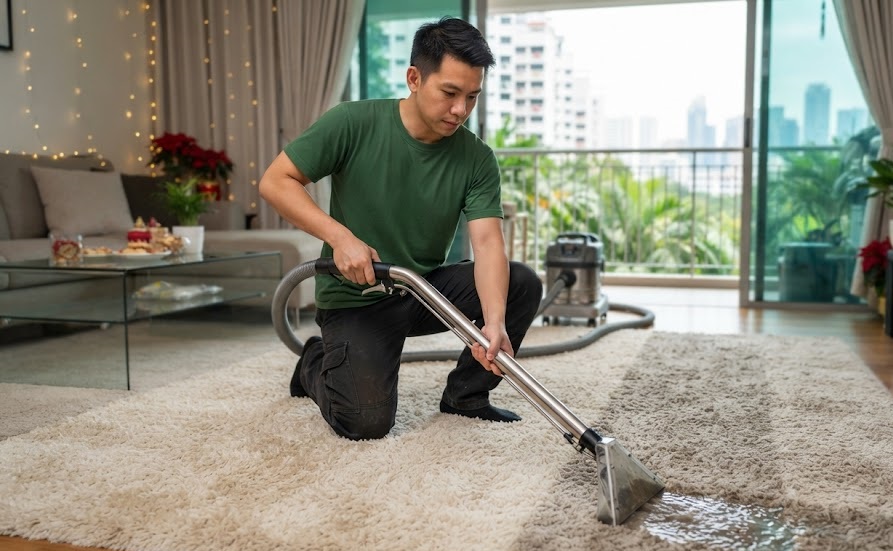
As major festive seasons approach in Singapore—whether Chinese New Year, Hari Raya Puasa, Deepavali, or Christmas—homeowners across HDB heartlands, BTO estates, and private condominiums embark on extensive pre-festive spring cleaning. The living room serves as the central hosting stage for open-house visits, multi-generational family reunions, and catered gatherings. High-traffic living room carpets and decorative area rugs frame these communal spaces, bearing the physical impact of heavy foot traffic, accidental food spills, and accumulated indoor soil.
Over months of daily family use, living room carpets develop unsightly grey traffic lanes between entrance doorways, sofa lounges, and dining areas. Simultaneously, stubborn remnants of past celebrations—curry oil drips, pineapple tart butter, boba tea syrup, and dark soy sauce spots—dull the carpet’s original color and texture. Achieving a pristine home environment ready for festive visitors requires moving past superficial surface vacuuming to execute targeted hydro-extraction and fiber-level stain remediation.
Pre-Festive Spring Cleaning & The Traffic Lane Phenomenon in Singapore Homes
Living room carpets suffer from a specific structural degradation process known as the Traffic Lane Phenomenon. In high-footfall zones between the main door entrance, coffee table, and sofa seats, carpet fibers experience continuous mechanical downward compression combined with lateral friction. This mechanical force causes two distinct problems:
- Mechanical Fiber Abrasion & Pile Matting: Walking crushes upright yarn tufts, forcing individual filament strands to twist, bend, and interlock. Over time, light reflection off crushed fibers changes, making traffic pathways appear permanently dark and worn even when dry-vacuumed.
- Sebum & Fine Dust Electrostatic Bonding: Bare feet and house slippers transfer natural body oils (sebum) onto carpet fiber tips. Sebum acts as a sticky binder, trapping atmospheric dust, footborne soil, and fine cooking grease carried out from kitchen open-concept layouts. This oil-dirt matrix coats fiber shafts, turning yarn tufts dark grey.
Compounding this traffic lane darkening are complex food and beverage stains accumulated during previous family meals and gatherings:
1. Curries, Rendang & Sambal Oils (Turmeric & Capsicum Pigments)
Traditional Singaporean festive dishes rely heavily on coconut milk, palm oil, and turmeric (curcumin). Curcumin is a natural oil-soluble yellow dye that penetrates deeply into synthetic nylon and natural wool fibers. Standard water-based cleaners fail because water cannot dissolve lipophilic turmeric oils.
2. Pineapple Tarts, Kueh Lapis & Butter Shortbread Fats
Crumbled pastries drop butter fats and caramelized sugar into carpet roots. As foot traffic steps on these crumbs, friction melts dairy lipids, grinding organic fats deep into the primary carpet backing.
3. Bubble Tea, Syrups & Alcoholic Beverages
High-fructose corn syrup, tapioca starch binders, and red wine tannins form sticky crystal matrices around carpet shafts upon drying. These sugar residues attract surrounding dust particles like a magnet.
Why DIY Store-Bought Foam Cleaners Cause Permanent Fiber Damage
Faced with stubborn stains right before a major festive gathering, homeowners often rush to supermarket aisles to purchase aerosol carpet spotters, carpet foam sprays, or high-alkaline dishwashing liquids. Applying these off-the-shelf retail chemicals frequently leads to permanent carpet damage.
Retail spotters fail due to two chemical pitfalls:
1. High-pH Surfactant Residue & Re-Soiling Traps
Consumer spot removers utilize cheap, high-alkaline surfactants ($pH\ 9.5 – 11.0$) blended with optical brighteners. While these chemicals temporarily bleach surface dirt to make stains appear lighter, they cannot extract the liquid soil out of the carpet. Without a high-pressure vacuum extraction pass, sticky soapy residues remain behind on the carpet fibers. Within 48 hours of cleaning, this soap residue catches everyday dust, creating a dark, sticky spot larger than the original stain.
2. Sub-Surface Soil Wicking
Rubbing or scrubbing a carpet spot with a wet cloth or sponge pushes liquid food dyes downward into the secondary backing latex and foam underlayment. As the carpet slowly air-dries over 24 hours, moisture evaporates from the surface tips upward. This evaporation creates capillary action, drawing dissolved dirt and food dyes back up from the wet backing to the surface fiber tips—a process known as soil wicking. Homeowners wake up the next morning to find old stains reappearing overnight.
| Stain / Contaminant Category | Chemical Breakdown Agent | Fluid Injection Temp & PSI | Extraction Flush Efficiency | Post-Treatment Protection Value |
|---|---|---|---|---|
| High-Traffic Sebum & Soil Tracks | d-Limonene Solvent Emulsifier | 80°C – 85°C / 400 PSI | 95% (Strips oil-bound soil) | Essential (Restores pile resiliency) |
| Turmeric / Curry / Sambal Oils | Photo-Oxidizing Solvent Pre-Spotter | 85°C – 90°C / 450 PSI | 90% – 95% (Breaks curcumin dye bonds) | High (Prevents oil re-absorption) |
| Pineapple Tart & Pastry Fats | Lipolytic Bio-Enzymatic Pre-Spray | 75°C – 85°C / 350 PSI | 98% (Emulsifies dairy lipids) | High (Eliminates rancid lipid odor) |
| Red Wine & Tannin Beverage Spots | Acidic Reducing Agent (pH 4.5) | 60°C – 70°C / 300 PSI | 92% – 96% (Strips anthocyanin dyes) | Critical (Prevents permanent setting) |
Deep Hydro-Extraction & Fluorochemical Fabric Protection Mechanics
Restoring living room carpets for festive hosting requires combining specialized pre-treatment chemistry with high-pressure thermal hydro-extraction. Following deep extraction, applying advanced fluorochemical fabric protection seals individual fiber shafts against future holiday spills.
The restoration framework operates across four technical phases:
Phase 1: Targeted Bio-Enzymatic & Solvent Pre-Spotting
Specific stain types receive targeted chemical pre-conditioning. Lipolytic bio-enzymes digest butter fats and milk proteins, while specialized solvent emulsifiers break down oily turmeric pigments and traffic lane sebum. Counter-rotating cylindrical brushes (CRB) work these agents deep into the pile, lifting crushed fiber tufts without untwisting yarn heat-sets.
Phase 2: High-PSI Thermal Hydro-Extraction & Neutralizing Flush
High-temperature water (80°C–85°C) containing an acidic neutralizing rinse ($pH\ 4.5 – 5.5$) is injected into the pile at 350 to 450 PSI. The acidic rinse neutralizes pre-spray alkalinity, dissolves soapy residues, and flushes emulsified soil slurry into high-lift vacuum intake wands.
Phase 3: Mechanical Pile Grooming & Boundary Layer Drying
A professional carpet rake grooms crushed yarn tufts back into an upright orientation, restoring uniform pile geometry and light reflection. High-velocity axial air movers are positioned across the carpet face, drying fibers within 3 to 4 hours.
Phase 4: Fluorochemical Fabric Protector Application (Stain Guarding)
Once extracted, fibers are treated with a low-surface-tension C6 fluorochemical coating. Fluorochemical polymers bond to yarn shafts, lowering carpet surface energy below the surface tension of water and oil ($< 20\ \text{dynes/cm}$). When a guest accidentally knocks over a glass of fruit punch or drops curry gravy during an open-house gathering, the liquid cannot soak into the fiber core. Instead, it beads up on top of the pile like mercury, allowing hosts to blot the spill away cleanly with a dry napkin. Homeowners seeking complete pre-festive floor restoration can book specialized treatment through professional stain removal and fabric protection services.
Protecting High-Traffic Living Room Carpets During Open House Gatherings
Preparing living room carpets before festive celebrations is only half the battle; preserving carpet appearance while hosting dozens of relatives, friends, and neighbors during open-house visits requires proactive management. During peak festive days, a living room rug experiences more foot traffic in 48 hours than it normally encounters across three months of routine family use.
To keep carpets looking pristine throughout multi-day hosting periods, observe three practical home management rules:
- Implement a Breathable Indoor Slipper Policy: While removing outdoor shoes at the front door is standard practice across Singapore homes, walking on carpets in bare feet transfers body oils (sebum) directly onto yarn tips. Provide soft, washable cotton or felt indoor house slippers for guests to wear inside living spaces.
- Position Absorbent Transition Runners at Entryways: Place high-density cotton transition mats at the main door entryway and at kitchen or balcony thresholds. These mats catch residual shoe dampness and food debris before guests step onto living room area rugs.
- Maintain Active Climate Control (Dry Mode Air Conditioning): When hosting large groups indoors, body heat and humidity spike rapidly. Running split-system air conditioning in “Dry Mode” keeps indoor relative humidity below 60%, preventing carpet fibers from absorbing ambient air moisture and becoming sticky under foot traffic.
If a guest knocks over curry gravy, red wine, or boba tea during an open-house gathering, act immediately:
1. Blot, Never Scrub: Press a clean, dry white cotton towel firmly over the liquid. Scrubbing or rubbing breaks carpet fibers and forces food dyes horizontally into surrounding yarn.
2. Cold Water Dilution: Lightly mist cold water onto the spot from the outside edges inward to dilute sugar and pigments. Hot water sets tannin and protein stains permanently.
3. Avoid Dish Soap or Vinegar: Never pour household dish soap or white vinegar onto the stain. Dish soap leaves sticky residues that attract dirt, while acidic vinegar reacts with food dyes to fix color pigments permanently into nylon fibers.
Material-Specific Restoration: Synthetic Living Room Rugs vs. Delicate Wool Area Rugs
Different carpet fiber materials present unique physical properties during deep pre-festive cleaning. Calibrating fluid temperature, injection pressure, and surfactant chemistry ensures safe restoration without fiber distortion.
1. Synthetic Cut-Pile Rugs (Nylon BCF, Polypropylene, Polyester)
Synthetic living room carpets withstand aggressive cleaning parameters. Nylon and olefin fibers handle thermal injection temperatures up to 85°C–90°C and fluid pressures up to 450 PSI. Solvent pre-sprays containing d-limonene easily dissolve oily traffic lane tracks and stubborn food grease. Following extraction, synthetic fibers respond well to C6 fluorochemical stain guarding, achieving high fluid repellency within 2 hours of application.
2. High-End Natural Wool & Silk Blend Area Rugs
Natural wool area rugs—commonly found in Bukit Timah, East Coast, and Orchard condominiums—require gentle handling. Wool fibers possess an outer protective cuticle layer composed of hydrophobic protein scales. Applying high heat or high-pH alkaline detergents strips natural lanolin oils, causing wool fibers to become brittle, dry, and yellow. Wool restoration guidelines require strict operating limits:
- Temperature Control: Injection fluid temperatures must not exceed 65°C to prevent fiber felting, shrinkage, or dye bleeding.
- pH Neutralization: Pre-sprays and extraction rinses must remain strictly within a wool-safe pH window of 5.5 to 8.0.
- Airflow Drying: Wool fibers hold up to 30% of their weight in moisture without feeling wet. Immediate high-velocity axial fan drying is necessary to prevent wool backing dampness and musty odors.
Pre-Festive Cleaning Timeline & Host Planning Checklist
During peak pre-festive periods (the 4 weeks leading up to Chinese New Year, Hari Raya, or Deepavali), professional carpet cleaning demand across Singapore increases significantly. Booking and executing carpet restoration according to a structured timeline avoids host stress and guarantees flawless results:
10 to 14 Days Before Festival: Booking & Inspection
Schedule an in-home assessment or submit carpet photographs for stain diagnosis. Confirm carpet fiber composition (synthetic vs. wool) to ensure technicians bring correct bio-enzymes, acidic rinses, and fluorochemical protectors.
5 to 7 Days Before Festival: Professional Hydro-Extraction Execution
Conduct deep hydro-extraction early in the week. This timing allows living room carpets to undergo full hot water extraction, pile raking grooming, high-velocity fan drying, and fluorochemical protector curing without interfering with food preparation, furniture rearranging, or last-minute festive decor installation.
2 to 3 Days Before Festival: Final Vacuum Pass & Furniture Placement
Perform a light dry HEPA vacuum pass to align carpet pile yarns. Reposition coffee tables, accent chairs, and festive decoration displays over fully dried, protected carpets.
Frequently Asked Questions
How far in advance of Chinese New Year or Hari Raya should I book carpet deep cleaning?
You should book professional carpet deep cleaning 2 to 3 weeks in advance of major festivals. Scheduling the actual cleaning pass 5 to 7 days before your first open-house gathering ensures carpets are completely dry, pile yarns are groomed, and fluorochemical stain protectors have fully cured.
Can old, set-in curry or wine stains from last year’s festive gathering be completely removed?
While fresh stains yield the highest removal success rates, old curry and wine stains can be significantly reduced or completely eliminated using specialized photo-oxidizing solvent pre-spotters and acidic reducing agents during hot water hydro-extraction. Success depends on whether previous DIY attempts chemically bleached the carpet fiber dyes.
Is fluorochemical fabric protection safe for homes with toddlers and indoor pets?
Yes. Modern C6 fluorochemical protectors are water-based, non-toxic, and free from harmful PFOS/PFOA compounds. Once applied and allowed to dry completely (approximately 2 to 3 hours), the protector cross-links into a non-reactive polymer shield that is safe for crawling toddlers and domestic pets.
How long does it take for living room carpets to dry after deep hot water extraction?
When performed by professional technicians utilizing high-lift vacuum extraction wands and high-velocity axial air movers, living room carpets dry completely within 3 to 4 hours. Running home air conditioning or ceiling fans further accelerates the drying process.
Welcome Guests to a Restored, Pristine Home
Preparing your living room for festive celebrations creates an inviting atmosphere for visiting family and friends. Restoring dark traffic lanes, extracting stubborn food stains, and applying protective stain guarding ensures your soft floor coverings remain plush, vibrant, and protected throughout the holiday season.
Ready to refresh your living room carpets and rugs before your upcoming festive gatherings? Contact our floor restoration team today through our online scheduling portal to secure an early spring-cleaning slot and receive a personalized pre-festive care consultation.